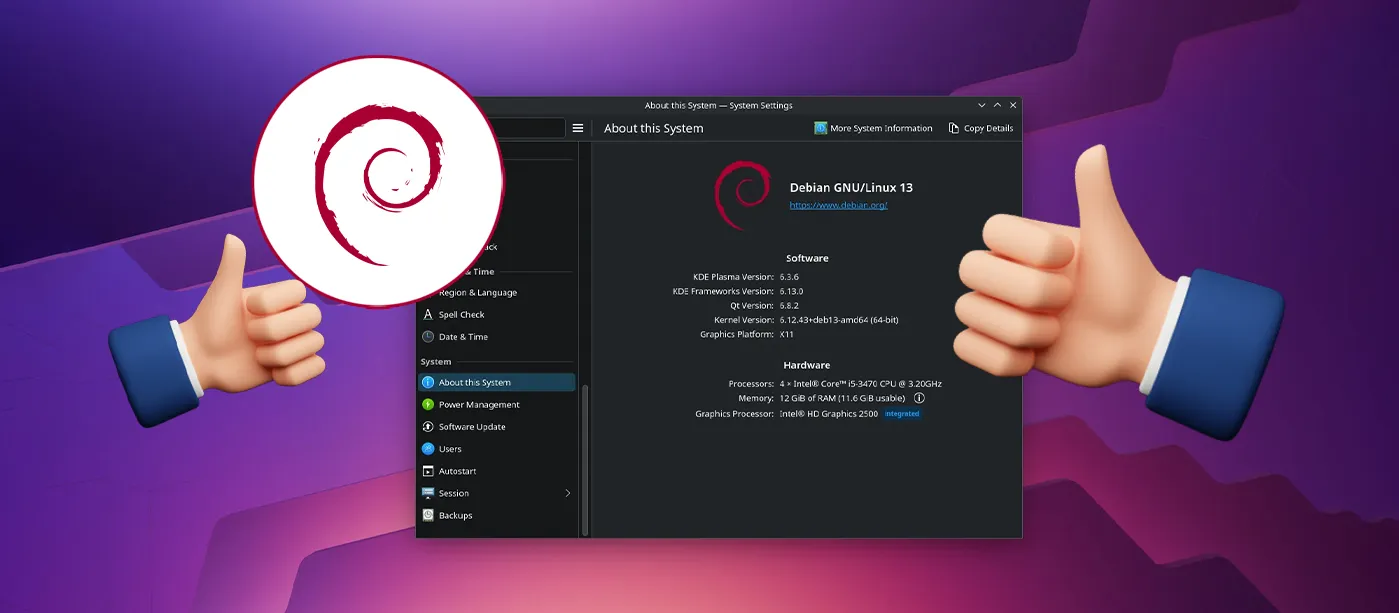
Let’s get something out of the way: we’re biased. We’ve been running Debian in production for years, we deploy it for our clients, and we’ve built a good chunk of our business around it. So yes, we have skin in the game. But that’s exactly why we think our opinion is worth hearing we didn’t pick Debian because of a marketing brochure. We picked it because we tried everything else first.
Over the past 15 years at IP Technics, we’ve worked with Red Hat, CentOS, SUSE, Oracle Linux, Ubuntu, and just about every flavour of Linux you can think of. We’ve deployed them in data centres across the UAE and beyond. And after all of that, we keep coming back to Debian. Here’s why.
Debian has been around since 1993. That matters.
Debian is older than Red Hat. It’s older than SUSE. Oracle Linux didn’t even show up until 2006, and that’s basically a RHEL clone with Oracle branding on top. Debian has been in continuous development for over 30 years, maintained by thousands of developers around the world who do it because they care about the software, not because they’re hitting a quarterly target.
That kind of longevity tells you something. Projects don’t survive three decades on hype. Debian survived because it works, because people trust it, and because the community behind it is genuinely committed to keeping it free and open. No corporate board is going to wake up one morning and decide to change Debian’s licensing model or restrict access to its source code. That actually happened with Red Hat and CentOS, by the way but more on that later.
Half the Linux world is built on Debian
Ubuntu? Built on Debian. Linux Mint? Built on Debian. Kali Linux, Raspberry Pi OS, Proxmox VE? All Debian. There are more distributions based on Debian than on any other Linux project. That’s not a coincidence. When the people building other operating systems need a solid foundation, they overwhelmingly choose Debian.
Think about that for a moment. Ubuntu powers a huge percentage of cloud workloads on AWS, Azure, and Google Cloud. And Ubuntu itself is built on top of Debian packages, Debian infrastructure, and Debian engineering. If Debian is good enough to be the upstream for the most popular Linux distribution in the world, it’s probably good enough for your servers.
Stable actually means stable
Debian’s release philosophy is simple: it ships when it’s ready. Not when a fiscal quarter demands it, not when the marketing team needs a launch event, not when a new feature needs to be bundled in to justify subscription renewals. It ships when the bugs are fixed and the packages are tested.
Every package in a Debian Stable release goes through the Unstable and Testing branches first, where thousands of developers and users hammer on it for months. By the time something reaches Stable, it’s been through more real-world testing than most commercial releases ever see. We’ve had Debian servers running for five, six, seven years with nothing but security patches applied. No surprises, no breakage, no 3 AM phone calls.
Red Hat and SUSE have good QA, we won’t deny that. But they also have business pressures. Release schedules get tied to sales cycles. Features get rushed in. Compatibility with partner products takes priority over simplicity. Debian doesn’t have any of that baggage. Its only job is to be rock solid, and it does that job extremely well.
The Debian LTS programme extends security support to five years or more, which matches or beats the support lifecycle of most commercial distributions. And it costs you nothing.
The software you actually use runs on Debian just fine
There’s a persistent myth that “enterprise software” doesn’t support Debian. Let’s unpack that.
PostgreSQL, MySQL, MariaDB all first-class citizens on Debian with official repositories. Docker and Kubernetes? Official Debian support, tested with every release. Nginx, Apache, HAProxy? Natively packaged. Zabbix, Grafana, Prometheus, Wazuh, the entire ELK stack? All ship official Debian packages. GitLab, Ansible, Terraform, HashiCorp Vault? Supported. Proxmox, which is one of the best virtualisation platforms available, is literally built on Debian. Even Microsoft SQL Server runs on Ubuntu, which, as we’ve established, is Debian underneath.
The list goes on. Zimbra, Nextcloud, Mattermost, Jenkins, Gitea, Redis, RabbitMQ, Elasticsearch, OpenSearch if it’s a modern infrastructure tool, chances are very high that it has official Debian support.
Let’s be honest about SAP and Oracle
We’re not going to pretend Debian is perfect for every single use case, because it isn’t. SAP HANA is only certified on RHEL, SUSE, and Oracle Linux. Oracle Database is primarily an RPM-world product. If you’re running those specific applications, you’re locked into commercial distributions and there’s no way around it.
But here’s the thing those are very specific, very large-scale enterprise workloads. They come with their own dedicated teams, their own budgets, and their own vendor relationships that dictate the OS choice long before anyone asks for our opinion. For everything else and that’s the overwhelming majority of what businesses actually run day to day Debian handles it beautifully.
We’d rather be upfront about this than pretend the limitation doesn’t exist. That’s how we operate.
No subscriptions, no lock-in, no surprises
When you build on RHEL, you’re not just choosing a Linux distribution. You’re signing up for a subscription model, proprietary management tools, and a dependency on a corporation that can change the rules whenever it wants. Oracle Linux? Same story, with Oracle’s famously aggressive licensing practices added to the mix. SUSE is somewhat better, but you’re still tying your budget to someone else’s pricing decisions.
Debian has none of that. No subscriptions, no licensing fees, no proprietary layers. The Debian Social Contract guarantees that it will always be free. Nobody is going to pull the rug out from under you. Your infrastructure stays yours.
RHEL subscriptions run anywhere from $349 to over $1,299 per server per year. Multiply that across your environment and you’re spending serious money on something that gives you no additional capability over Debian. That money could go toward better hardware, better monitoring, better people things that actually make a difference.
Credit where it’s due: Red Hat
We give Red Hat a hard time in this post, so let’s balance the scales. Red Hat has done enormous good for the open source world. They’ve contributed heavily to the Linux kernel, systemd, GNOME, Ansible, Podman, and OpenShift, among many other projects. They proved to the corporate world that open source could be trusted for serious, mission-critical work. That mattered, and the entire Linux ecosystem including Debian has benefited from it.
But Red Hat’s recent moves have troubled a lot of people, us included. Restricting access to RHEL source code, killing CentOS as a stable downstream and replacing it with CentOS Stream as a rolling beta these decisions feel like a company prioritising its commercial interests over the community that helped build it. It’s pushed a lot of organisations to reconsider where they put their trust. Debian, which has never wavered from its commitment to freedom and transparency, is the obvious alternative.
So who supports you? We do.
The biggest question people have about Debian in a business context is support. “If something breaks at 2 AM, who do I call?” Fair question.
You call us. IP Technics has been providing enterprise IT infrastructure support out of Dubai for over 15 years. We know Debian inside and out because we run it ourselves, for ourselves and for our clients. We’re not reselling someone else’s support contract we’re the engineers who actually fix the problems.
What that looks like in practice:
- Incident response and troubleshooting when things go wrong
- Proactive monitoring with Zabbix and Wazuh so things don’t go wrong in the first place
- Security hardening, patching, and compliance
- Migrations from RHEL, CentOS, Oracle Linux, or SUSE to Debian
- Cloud deployments across OVH, Hetzner, Google Cloud, and on-premises
- Integration with VMware, Proxmox, Active Directory, Kubernetes, and the rest of the stack
You get the stability and freedom of Debian with a real team standing behind it. That’s the combination that commercial Linux vendors don’t want you to know is possible.
The bottom line
Debian has been around for over 30 years. It’s the foundation for more Linux distributions than any other project. Its stability is proven, its software ecosystem is massive, and it costs you absolutely nothing. The enterprise tools you depend on databases, containers, monitoring, automation, virtualisation all run on it natively.
Yes, there are specific workloads like SAP where commercial distributions are still required. We’re honest about that. But for everything else, paying for a commercial Linux subscription is paying for a brand name, not for better software.
We’ve been deploying Debian for years and we stand behind it with professional support. If you’re tired of vendor lock-in, escalating subscription costs, and corporate decisions that don’t serve your interests give Debian a serious look. And if you want a partner who knows it inside and out, get in touch.