Address Space
IPv4 supports roughly 4.3 billion addresses, and they are effectively exhausted. IPv6 provides a virtually unlimited address pool, eliminating the need for NAT workarounds and address sharing that add complexity and break applications.

servicesIPV6
IPv4 addresses are running out. In the UAE and across the GCC, businesses are already competing for a shrinking pool of available addresses, and the cost of acquiring IPv4 space is climbing every year. IPv6 is not a future technology. It is a current requirement for any organisation planning to grow, connect IoT devices, or maintain reliable connectivity.
We have been deploying IPv6 across enterprise networks, data centres, and cloud environments for years. We handle the complexity so your team does not have to.
Switching to IPv6 is no longer optional; it’s essential. As IPv4 addresses become scarce, IPv6 provides a sustainable solution packed with benefits. Here’s why it matters:
IPv4 supports roughly 4.3 billion addresses, and they are effectively exhausted. IPv6 provides a virtually unlimited address pool, eliminating the need for NAT workarounds and address sharing that add complexity and break applications.

IPv6 was designed with IPSec built in from the start. End-to-end encryption and authentication are native to the protocol, not bolted on as an after thought.

Simplified packet headers mean faster routing. No NAT translation overhead. Multicast replaces broadcast. The result is cleaner, more efficient network traffic.

Every connected device needs an address. Smart buildings, industrial sensors, medical devices, and fleet tracking all depend on abundant addressing. IPv6 makes this scalable without workarounds.

We audit your current network infrastructure, applications, hardware, and ISP connectivity to identify what supports IPv6 today and what needs attention. You get a clear picture of where you stand.

Proper IPv6 address allocation and subnetting for your organisation. Structured addressing schemes that make sense for your sites, departments, and growth plans.

Run IPv4 and IPv6 in parallel during transition. Existing services continue to work on IPv4 while new services and devices use IPv6. This is the safest migration path for most organisations.

Every firewall rule, ACL, and security policy needs to be reviewed and extended for IPv6. We update your OPNsense, Fortinet, Sophos, or Cisco configurations to ensure IPv6 traffic is controlled to the same standard as IPv4.

AAAA record management, reverse DNS for IPv6, and DNS64/NAT64 where needed for compatibility with IPv4-only services.

We test your business applications, VoIP systems, email, VPN, and web services to confirm they work correctly over IPv6 before cutover.

Working with your internet service providers to enable IPv6 connectivity, configure BGP peering where applicable, and verify end-to-end reachability.

We train your network and IT teams on IPv6 addressing, troubleshooting, and day-to-day management so they are confident after handover.

Before full implementation, pilot tests help detect and resolve any issues early. This guarantees a smooth transition without unexpected complications.

IPv6 migration is a strategic investment that future-proofs your business. By making the transition now, you avoid the constraints of IPv4 and gain a network built for scalability and security.
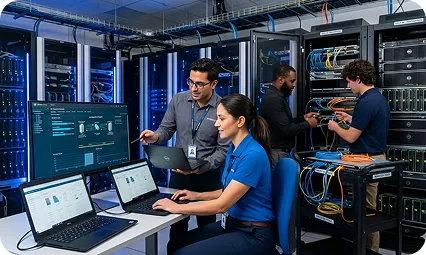
Our work does not end at deployment. We provide ongoing monitoring to verify IPv6 performance, troubleshoot any issues that surface after migration, and help you extend IPv6 to new sites and services as your network grows.
IP Technics delivers expertise and reliability in IPv6 migration. Contact us today to explore how we can help your business navigate this transition efficiently and securely.